System Capability
System capability was firstly determined for each mine based upon the observed cycle times at each mine, as shown in Figure 1. A process rate was generated for each mine through the pillar development cycle (in 16m increments) including the conveyor roadway, cut through, and transport roadway.
It was evident from the results as depicted in the graphs, that the steeper the process rate the more that the process is wheeling constrained, and the flatter the process rate the more the process is support constrained. Some mines have evidence of both constraints, with the wheeling constraint becoming evident as the wheeling distance increases, while mines that install additional supports (tendons) in intersections suffer a dramatic affect on their process rate in that area.
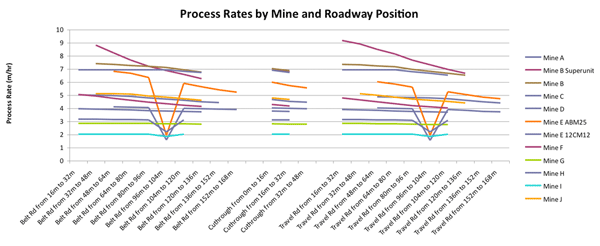
Figure 1: System Capability (Process
Rate) over the Pillar Advance Cycle
Based upon
the above system capabilities average advance or process rates were determined for
each mine under normal support conditions as shown in Figure 2.
|
Mine and Mining System
Employed
|
Process rate (m/hr)
|
|
B - Super
Unit
|
7.5
|
|
B
|
7.1
|
|
C
|
6.9
|
|
E (bolter
-miner)
|
5.0
|
|
J
|
4.8
|
|
A (bolter
-miner)
|
4.7
|
|
F
|
4.4
|
|
D
|
3.8
|
|
E
(miner-bolter)
|
3.6
|
|
H
|
3.0
|
|
G
|
2.8
|
|
I
|
2.5
|
|
Figure 2: Average Process
Rates by Mine